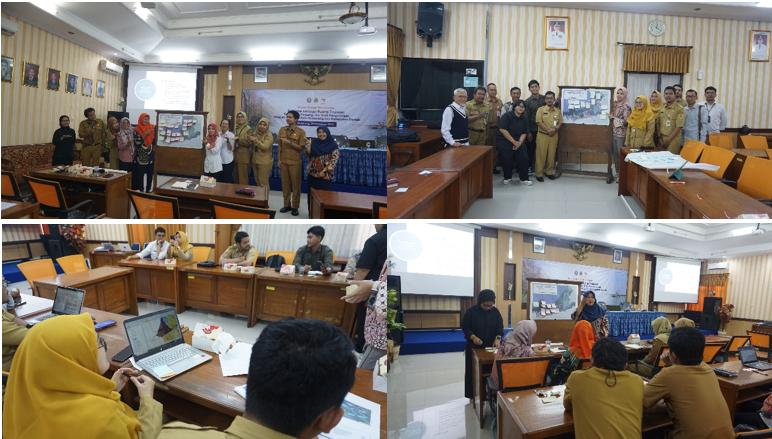
The Department of Urban and Regional Planning, Diponegoro University, conducted a Focus Group Discussion (FGD) to support the arrangement of a Policy Brief entitled “Ecotone as a Transitional Space: Challenges, Opportunities, and Strategies for the Management of the Semarang–Demak Coastal Area”. The discussion was attended by 32 participants representing academia, central government institutions, the Provincial Government of Central Java, the Municipal Government of Semarang City, the Government of Demak Regency, and the business and industrial sector (DUDI). The meeting was held at the Prayogasala Meeting Room, the Regional Research and Innovation Agency (BRIDA) of Central Java Province, Semarang, on November 24, 2025. The Focus Group Discussion (FGD) was organized within the framework of the Collaboration Program with the Business and Industrial Sector (DUDI). It formed part of Diponegoro University’s World Class University (WCU) agenda. Implemented in partnership with the Regional Research and Innovation Agency (BRIDA) of Central Java Province, the activity formed part of a collaborative research initiative aimed at introducing and facilitating policy dialogue on the characteristics, dynamics, and strategic management directions of ecotone areas in the Semarang–Demak coastal region.
The discussion was formally opened by the Diponegoro University research team, led by the Head of the Department of Urban and Regional Planning, Prof. Dr. -Ing. Wiwandari Handayani, S.T., M.T., MPS. The opening statements emphasized the importance of research collaboration and a shared strategic understanding among stakeholders in advancing discussions on the ecotone concept as a transitional spatial framework for the coastal areas of Semarang City and Demak Regency. Furthermore, the Head of the Regional Research and Innovation Agency (BRIDA) of Central Java Province, Drs. Mohamad Arief Irwanto, M.Si, expressed strong institutional support for the initiative and underscored the significance of the study as part of broader efforts to address challenges in the Semarang–Demak coastal area. Research-based support was highlighted as essential for the Provincial Government of Central Java, particularly in addressing infrastructure, environmental, social, and economic challenges affecting coastal regions.
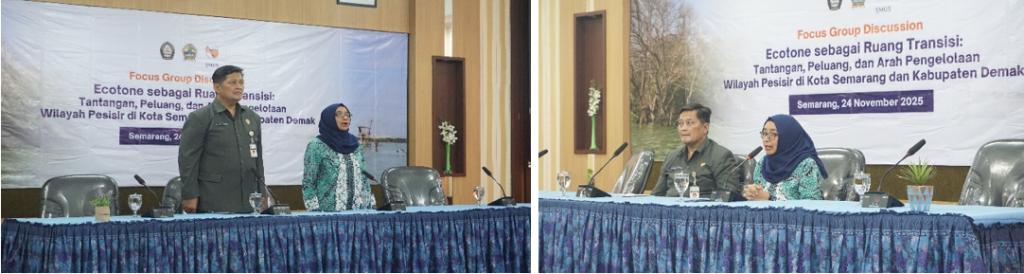
The subsequent session featured expert presentations delivered by Prof. Dr.sc.agr. Iwan Rudiarto, S.T., M.Sc., from the Department of Urban and Regional Planning, Diponegoro University, and Arif Sofianto, S.IP., M.Si., from the Regional Research and Innovation Agency (BRIDA) of Central Java Province. Moderated by Dr.-Ing. Santy Paulla Dewi, S.T., M.T., the session featured a presentation by Prof. Iwan Rudiarto focused on the characteristics and dynamics of ecotone areas as transitional spaces, with particular emphasis on ongoing land-use change in peri-urban areas and socio-economic transformations within rural–urban transition zones along the Semarang City–Demak coastal area. These dynamics were identified as priority issues requiring policy attention.
In addition, Mr. Arif Sofianto of the Regional Research and Innovation Agency (BRIDA) of Central Java Province emphasized the multiple challenges facing the province’s coastal areas, including land subsidence and sea-level rise. He outlined priority initiatives of the Provincial Government of Central Java to address these challenges, including the planned development of a hybrid sea wall, floating housing schemes, and coastal conservation measures under the ‘Mageri Segoro’ program. The session concluded with responses and inputs from representatives of central government institutions, local governments, and the business and industrial sector (DUDI).
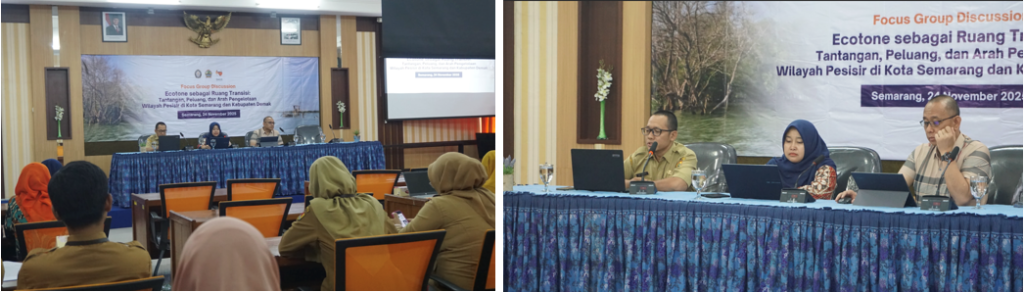
The final session consisted of an interactive policy dialogue facilitated by Astrini Ayu Puspita, S.T., M.T., from the Department of Urban and Regional Planning, Diponegoro University. Participants were divided into two working groups focusing on the Semarang coastal area and the Demak Regency coastal area. Key discussion points included the identification of critical issues, the formulation of priorities and response needs, and the development of policy directions for the management of ecotone areas. The session concluded with the presentation of key conclusions from each group. The discussions underscored the need for an integrated approach to coastal management in Semarang City and Demak Regency. Coastal protection infrastructure, including the development of continuous coastal embankments, was identified as a primary measure to safeguard both coastal and inland areas. In addition, land-based interventions were highlighted, particularly the need to address land tenure and restore land rights lost due to recurrent tidal flooding. Key challenges in the housing and settlement sector were also identified, including the implementation of floating housing programs and the anticipation of housing relocation for communities affected by tidal inundation. The FGD is expected to generate research-based innovations to support the sustainable development agenda, particularly in advancing Sustainable Cities and Communities (SDGs 11), Climate Action (SDGs 13), and Partnerships for the Goals (SDGs 17), while strengthening collaboration between academia and relevant stakeholders in coastal development initiatives in Central Java Province.